A friend asked me a question I couldn't shake. "Where is Prudence?"
She meant the virtue. The four cardinal virtues of the Renaissance mind were Justice, Temperance, Fortitude, and Prudence — and if you pull a Rider-Waite-Smith deck off your shelf right now, you'll find three of them sitting in the Major Arcana as plain as day. Justice. Temperance. Strength, which is Fortitude in different clothes. And then a silence where the fourth should be.
✦ The Three That Stayed
This isn't a modern oversight. It goes all the way back to the beginning. The Visconti-Sforza deck — one of the oldest tarot decks we have, hand-painted in Milan around 1450 — carries Temperance, Fortitude, and Justice as trumps in their own right. Prudence never made the cut. The slightly earlier Cary-Yale deck tells the same story: three cardinal virtues present, one conspicuously absent.
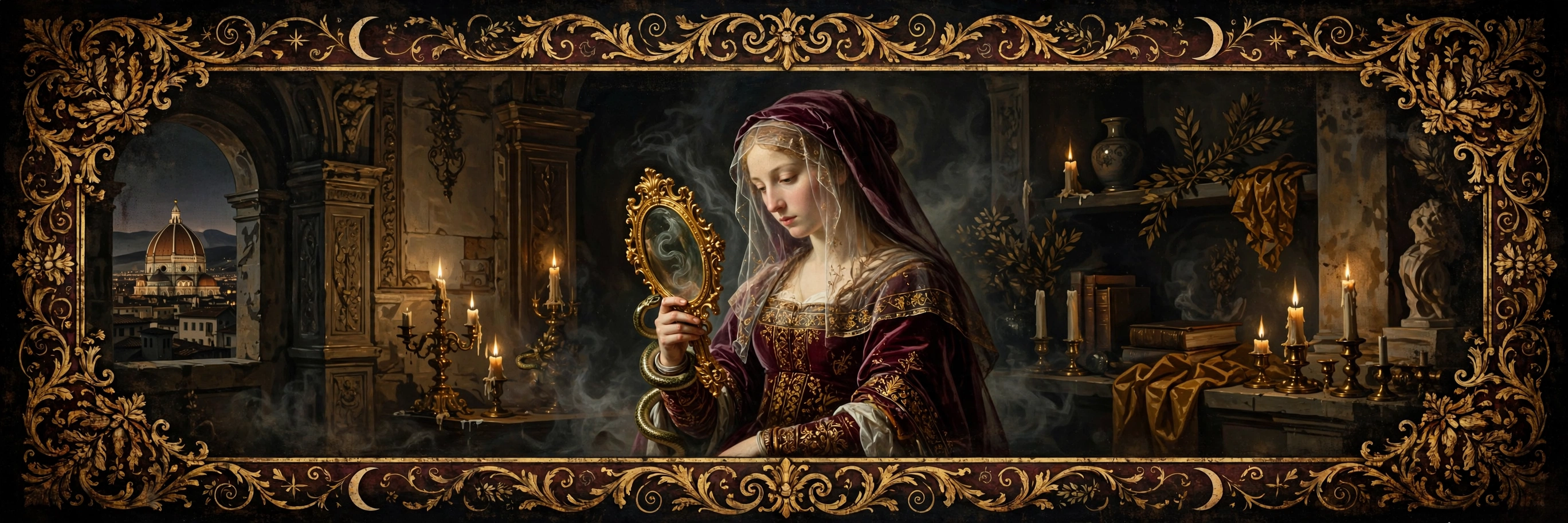
In Renaissance imagery, Prudence wasn't given armor or scales or a sword like her sisters. She was shown as a woman gazing into a mirror, often with a serpent coiled beside her — self-knowledge and cunning wisdom in one image. It's a striking picture. Some tarot historians think it may be exactly why she never got a permanent seat: too serpentine, too close to older pagan imagery for a deck trying to stay respectable. Others think her territory — reflection, self-knowledge, discernment — simply got absorbed into a card that already existed. The Hermit, lantern raised, walking alone, does looks an awful lot like Prudence in disguise.
So the standard 78-card tarot we know today — the one that gave us Rider-Waite-Smith, and Deviant Moon, and every deck descended from that Milanese original — simply never carried her forward. Three virtues became the tradition. The fourth got quietly written out of the story.
Except she wasn't written out everywhere. She just went to Florence instead.
✦ Enter the Minchiate
The Minchiate is tarot's stranger, more ambitious cousin — a Florentine deck that first appeared in the early 1500s under the name germini, and eventually swelled the standard 78 cards into a staggering 97. It kept everything the familiar tarot has. Then it kept going.
Where a standard deck stops at 22 trumps, the Minchiate carries 41. The extra 20 were inserted as a single block right after the Devil and before the Star — which is exactly the kind of thing that happens when someone Renaissance-era decides three virtues simply weren't enough:
There she is. Card 17. Sitting between Hope and Faith, completing a foursome of theological virtues that joins the three cardinal virtues — Temperance, Fortitude, and Justice — the standard deck already had. Prudence didn't get slipped into a gap left by someone else. The whole block of 20 cards was inserted together: the four virtues above, then the four classical elements (Fire, Water, Earth, Air), then all twelve signs of the zodiac, running from Libra to Gemini. Ninety-seven cards. A deck built less like a fortune-telling tool and more like a Renaissance textbook of everything the educated mind was supposed to hold at once — virtue, element, and star sign, laid end to end.
✦ The One Who Actually Vanished
Here's the turn in the story, and it's the one that belongs to this chapter specifically. If Prudence isn't really the missing card — she's alive and well in Florence, numbered and accounted for — then who is?
The High Priestess, called the Popess in the old tongue, is trump 2 in nearly every early tarot deck on record. She's in the Visconti-Sforza. She's in the Cary-Yale. She's in the old Rosenwald sheets. But she is not in the Minchiate. Scholars who've traced the deck's evolution find her missing from the standardized 97-card structure entirely — dropped somewhere along the way to Florence, with no formal explanation on record. A few readers propose that the Minchiate's Faith card quietly absorbed her role, the way the Hermit may have absorbed Prudence's. But there's no confirmed correspondence. She's simply gone.
So the deck that went out of its way to give Prudence a permanent home is the very same deck that lost the High Priestess along the way. One virtue got rescued. One woman got left behind. If that isn't a fitting thing to sit with on a page in her own chapter, I don't know what is.
✦ Can You Still Get One?
Yes — the Minchiate never fully died out, and it's had a few lives since. Lo Scarabeo has published a photo reproduction of an actual 1725 Florentine deck, all 97 cards intact with the virtues, elements, and zodiac trumps exactly as they were three hundred years ago. In 1999, tarot artist Brian Williams released his own hand-illustrated reworking, staying close to the Renaissance originals while making the whole system usable for a modern reader. Smaller printers and independent makers put out their own reproductions of the historic Etruria deck as well, so if this stirred something in you, the deck itself isn't lost to history the way Prudence briefly seemed to be. It's just waiting in a corner most readers never wander into.
I keep coming back to the mirror and the serpent. Self-knowledge was never loud about itself — it doesn't announce, it reflects. Maybe that's why Prudence was so easy to lose track of, and so easy to find again once you knew where to look. Maybe that's true of more than just a tarot card.
The next time someone tells you a piece of the old wisdom went missing, look twice. Sometimes it just moved to Florence.
"I wisdom dwell with prudence, and find out knowledge of witty inventions." — Proverbs 8:12
✦ Nothing Is Ever Truly Lost ✦