I asked her who did the reading. An AI, she said. She had asked for a Celtic Cross.
That is where the problems started. Not with the cards. With the cross.
I offered to take the photos she had and do a proper read off them — which is genuinely difficult, because when you don't know how someone pulled the cards, you don't know how to orient what you're seeing. The layout isn't decoration. It's the grammar of the sentence. Change the order, and you change what the cards are saying entirely.
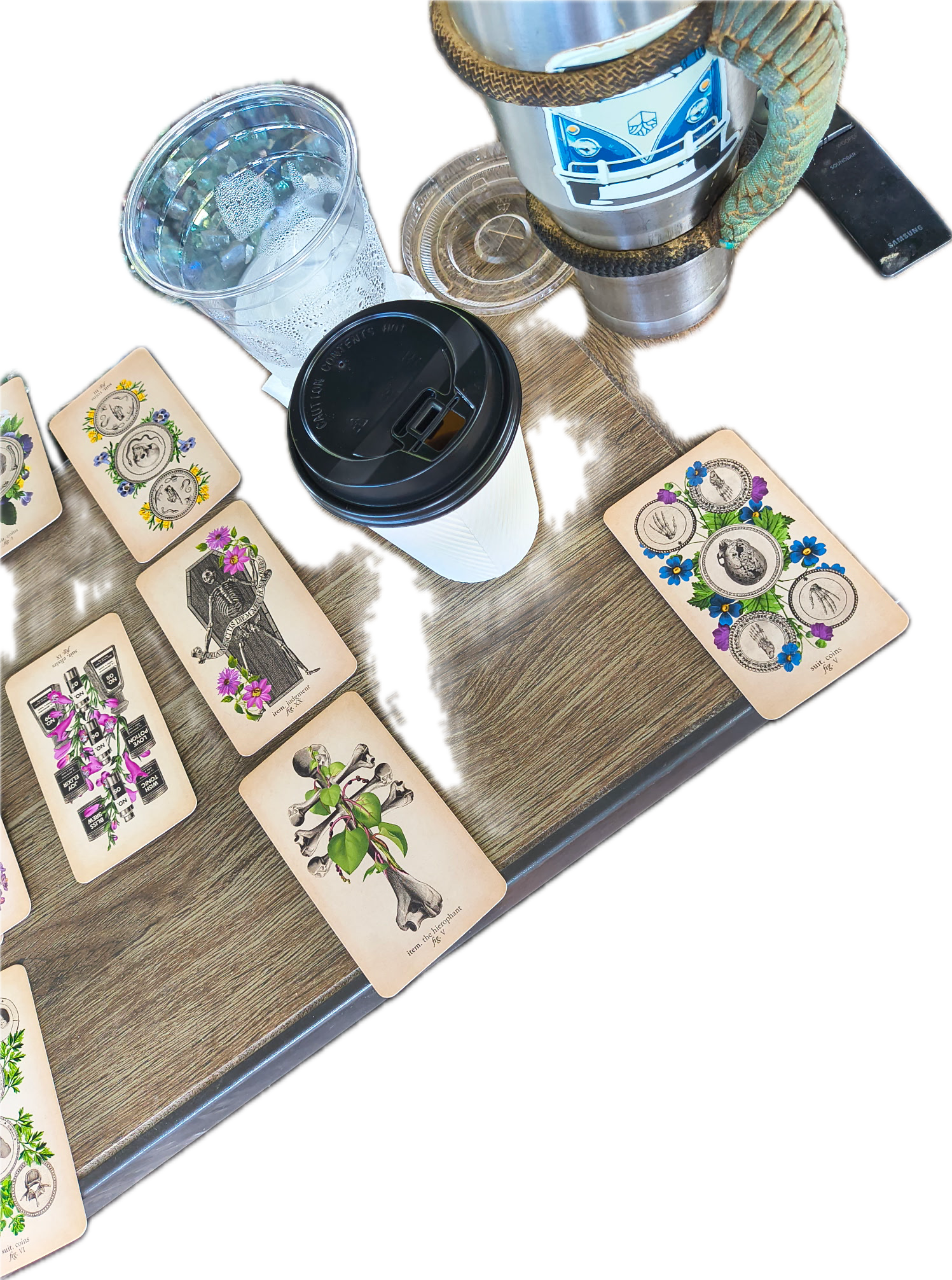
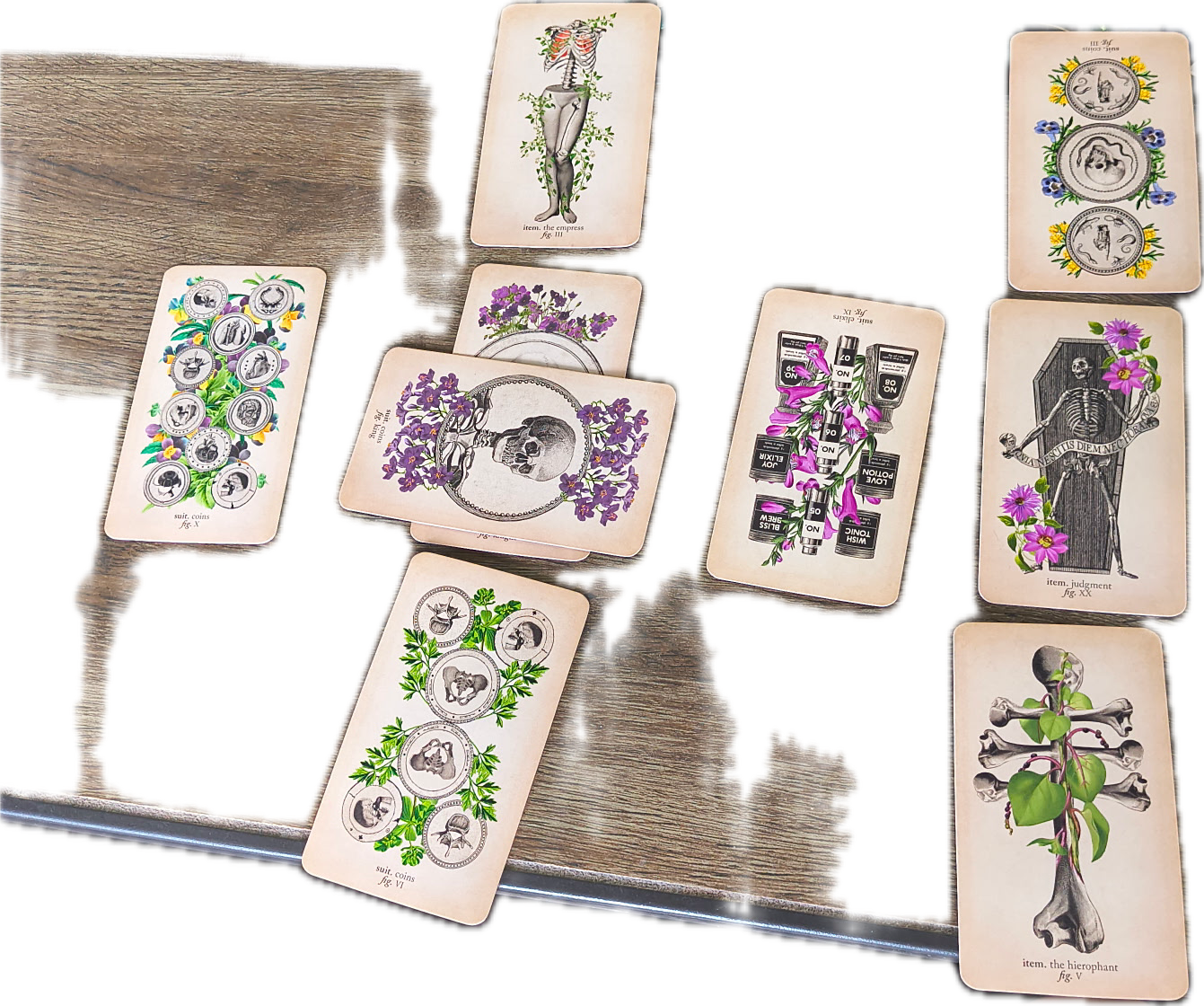
The spread in question — Antique Anatomy Tarot, a challenging deck to read cold.
Why Layout Is the Whole Conversation
The Celtic Cross is the spread most people have heard of. It is also the spread where I see the most variation — and the most confusion about what that variation means.
Here is what I know: there is no single correct Celtic Cross. What there is, is your Celtic Cross. The one you were taught, the one that has internal logic, the one you use consistently every time so that position nine means the same thing in every reading you ever do.
My grandmother taught me her version. Her mother taught her. Neither of them had ever heard of Arthur Edward Waite, and I can promise you my grandmother was not doing readings at the Vatican — she was Protestant Irish, and that would be its own kind of miracle.
Two Traditions, One Spread
Here is where the two methods diverge. Open both and compare. Neither is wrong. But you need to know which one you're using before you turn over card one.
Grandma's Way ▾
The Inner Cross — The Spiritual Diamond
-
1
The HeartThe present situation. Laid face up — the only card placed face up from the start.
-
2
The CrownPlaced at the top — your highest potential, conscious thoughts, what you strive toward.
-
3
The FoundationPlaced at the base — the root, the subconscious, deep past influences.
-
4
The PastLeft of center — where you are coming from.
-
5
The FutureRight of center — where the situation is immediately heading.
-
6
The ProblemLaid across card one — the immediate obstacle crossing the heart of the matter.
The Staff — The Ascending Path
Reads ground up — growth, climbing, building toward a result.
- 7Base of StaffYour internal state — fears, self-image, how you see yourself.
- 8Second StepYour environment — home life, the people around you.
- 9Third StepSecret hopes, guidance, or psychological blocks.
- 10The SummitThe ultimate outcome — where the journey ends.
The Waite Method ▾
The Inner Cross — The Circular Flow
-
1
The HeartThe present situation.
-
2
The CrossingLaid horizontally across card one — the immediate obstacle.
-
3
The FoundationPlaced below — root cause, past conditions.
-
4
The Recent PastLeft of center — energies passing out of your life.
-
5
The CrownPlaced above — conscious thoughts, goals, best potential outcome.
-
6
The Near FutureRight of center — the next immediate phase.
The Staff — The Vertical Ladder
Four cards in a vertical column on the right, built bottom to top.
- 7The SelfYour current state of mind, internal attitude, how you see yourself.
- 8The EnvironmentExternal influences — home, work, how others perceive you.
- 9Hopes & FearsUnderlying emotional vulnerabilities, subconscious desires, anxieties.
- 10The OutcomeThe culmination of the reading if you continue on your current path.
Do you see the difference? The crossing card — what I call the problem, what Waite calls the crossing — lands in position six in my grandmother's layout and position two in his. The crown and foundation are swapped. The circular energy moves differently than the compass energy.
When those positions shift, the cards shift. The same ten cards, in the same spots on the table, tell a completely different story depending on which map you're reading.
Who Invented the Celtic Cross, Anyway
A Brief and Humbling History
The version most people call the Celtic Cross was popularized by Arthur Edward Waite. He put it in the booklet that came with his deck — the Rider-Waite deck, named for himself and his publisher. The art was drawn by Pamela Colman Smith, whose name was an afterthought for most of the last century.
The deck and its accompanying booklet came out in the early 1900s. That's it. That's the ancient mystical tradition. A man wrote a book, a woman drew the pictures, and a publisher sold the set.
Tarot itself goes back much further — 15th-century Italian parlor games, aristocratic entertainment that slowly became a tool for divination over centuries. But the Celtic Cross layout as most people know it? That came from a pamphlet.
If this story sounds familiar, it should. It has the same shape as the Ouija board — something marketed as ancient that was actually a product.
So if my grandmother learned her layout from her mother, who learned it from hers, and none of them had ever opened a Rider-Waite booklet — what does that make my grandmother's version? Older? Different? Equally valid?
I would say: hers.
Because I said so.
She knew what she knew. She knew what her mother knew. That was enough.
So Which Layout Do You Use
Whichever one you know completely. Whichever one means the same thing in every reading, every time — so that when you flip card nine and it's the Tower, you already know what nine means before you even look at the image.
The layout is not the point. Consistency is the point. Knowing your positions so well they're automatic — that's the point.
An AI doesn't have that. It has access to the most common published version and applies it without knowing whether that's how the cards were pulled. That's not a reading. That's pattern matching on an incomplete map.
The cards were probably trying to say something real. They usually are. But without knowing the layout, you're reading a sentence in a language you haven't confirmed you're both speaking.
Some things are passed hand to hand.
And some things were never written down
because the people who knew them
didn't need to.