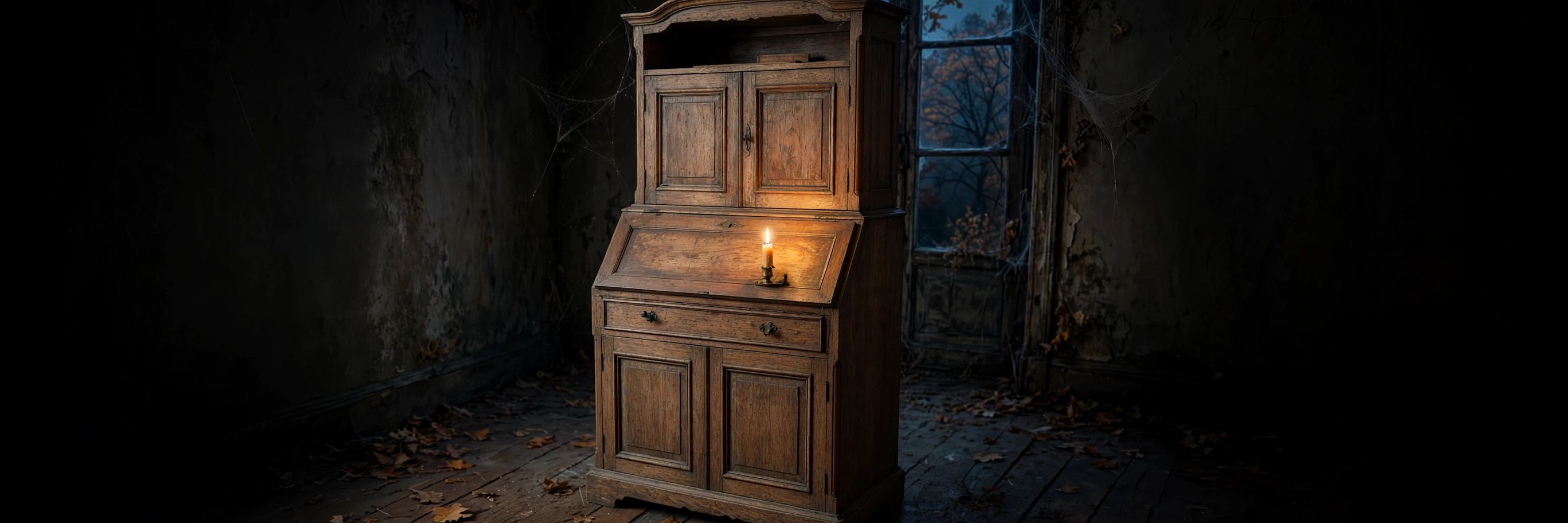
A Family That Knocked Back
Nobody in my family treated Charlie like a haunting. He was closer to a fixture — you didn't fear the desk any more than you'd fear an odd uncle who only came around when spoken to. A strange knock on a wall or a floorboard somewhere else in the house, though, got a different, older explanation entirely, one that had nothing to do with Charlie: that was the Tommyknockers, the same mine spirits who watch over Appalachian coal seams, following whoever in the family had carried them home from underground generations back. It was such an ordinary explanation that it barely qualified as spooky at the time. Something knocks, you say "that's just the Tommyknockers," and you go on with your evening.
It's only looking back on it now that I can see how strange that actually was — a house where knocking got answered two different ways depending on where in the house it came from, and nobody ever thought to question either one.
The Sisters Who Started It All
Long before Charlie's desk or any Appalachian mine, there were two young sisters in Hydesville, New York, who changed how an entire country listened to knocking. In 1848, Kate and Maggie Fox, ages eleven and fourteen, convinced their family that mysterious rapping sounds moving through their house were a spirit trying to communicate. Their mother devised the code herself, right there in the room: count to five, and the spirit rapped five times back. Count to fifteen, and it did that too. Word spread through the neighborhood, then the region, then the country. Within a few years, the Fox sisters were holding public séances for paying audiences of hundreds, "spirit rapping" had become a full-blown national craze, and a new religious movement called Spiritualism had been born from it — one that would eventually count Mary Todd Lincoln and Queen Victoria among the believers holding séances of their own.
Decades later, in 1888, Margaret Fox finally admitted the truth: there had never been a spirit. She and her sister had learned to crack their own toe joints silently against the floorboards, and pressed against wood, the sound carried like a knock from somewhere else in the room entirely. A parlor trick, dressed up as the voice of the dead. By the time she confessed, though, it hardly mattered. Spiritualism had already taken hold everywhere, and it never really let go. Every séance scene that's ever asked a spirit to knock once for yes and twice for no is still, whether it knows it or not, running the Fox sisters' code.
The Knock Hollywood Can't Let Go Of
There's a seven-note knock almost everyone in this country would recognize without being told its name: shave-and-a-haircut, two bits. It's an old vaudeville and barbershop tune, decades older than any horror movie, and the game built into it is simple and almost irresistible — once someone starts that rhythm, whatever's listening on the other side feels compelled to finish it. Hollywood noticed that compulsion a long time ago and has been using it to unsettle audiences ever since. In Who Framed Roger Rabbit, a Toon physically cannot leave the pattern unfinished, no matter how much danger finishing it puts him in. And in Insidious: Chapter 3, a girl named Quinn, laid up with two broken legs, hears a knock on her bedroom wall, assumes it's her neighbor, and taps back "shave and a haircut" as a joke between friends. Something on the other side finishes it for her. Her neighbor wasn't even home.
That's the same trick as a five-count and a fifteen-count from a Hydesville bedroom in 1848, dressed up in a different century's clothes. Start a pattern, and see what answers it. It worked on a nation of Spiritualists then. It still works on a theater full of people now.
Working With What Knocks Back
- A single, clear knock in answer to a direct question has been treated as a "yes" across traditions for well over a century
- Two knocks for "no" follows the same old code the Fox sisters' mother invented at her own kitchen table
- More than two, unprompted, unasked-for — that's not an answer to a question anymore. That's the warning to stop
- Whatever you're speaking to, familiar or not, deserves the same respect you'd give anyone else you called on by name
Charlie never needed a séance, a code invented under suspicion, or a movie script to make him what he was. He just needed someone willing to knock on old wood and ask a plain question, the way you'd ask anyone else sitting quietly in the room with you. Maybe that's the difference between a spirit that unsettles you and one that simply belongs to the family — whether anyone ever thought to be afraid of him in the first place.
Knock twice, and it tells you no.
Knock a third time, unasked —
and that is when you stop asking.
Some houses keep a name
for whatever is willing to answer.
Job 4:15 — "Then a spirit passed before my face; the hair of my flesh stood up." Even scripture knew the feeling of something passing close enough to answer.