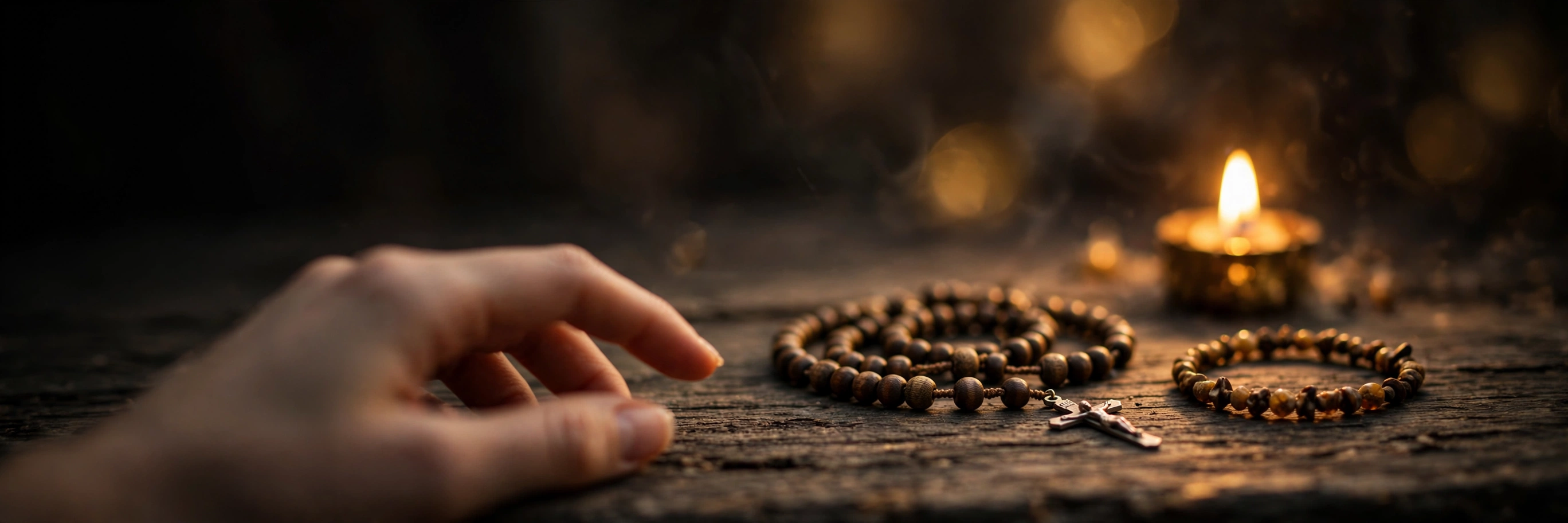
The Contrast
Children's rhymes have always been where the hard things went to hide. "Ring Around the Rosie" carried the plague in its pocket. "London Bridge Is Falling Down" carried a city's ruin. "Three Blind Mice" carried the executions of noblemen, tucked behind a nursery tune so plain nobody thought twice about singing it in the street. Terrible things survived for centuries because they learned to sound like nothing at all.
There is no equivalent for a witch counting. And once I looked at it plainly, the reason wasn't hard to find. A child caught singing "Ring Around the Rosie" was singing about a disaster that had already happened to everyone. A child caught singing about a witch counting — beads, bones, knots, anything — was pointing a finger at a house. At a grandmother. At a mother. The song wouldn't have protected the family the way the others did. It would have named them. So the rhyme was never safe to make, and it was never made. The silence isn't an empty spot in the folklore. The silence is the folklore.
What I Carried Instead
I was raised Methodist. I didn't come into the Catholic church until my thirties, and by then I'd already been given a beaded bracelet — homemade, a gift, not Catholic at all. It came with a little card explaining what each color meant: black for sin, red for the blood of Christ, white for purity, blue for baptism, green for growth in faith, gold for eternal life. I never took it off from the day I was given it.
It was still on my wrist years later, in a hospital room, while I sat with my dad in his final days — long hours, the kind that don't move — trying to hold on to some strength for my mother's sake more than my own. At some point, without deciding to, I started running those beads between my fingers. My mother wasn't Catholic, and by then neither was the bracelet, not really — it was just beads. She asked me to stop anyway. It was upsetting her, and I don't know to this day whether she understood what I was holding or just needed the motion to stop.
I put my hand still. And not long after, I started counting on my fingers instead. I think that's honestly how I've been doing it ever since.
Beads Are Older Than Any One Faith
Once you start looking, you find prayer beads almost everywhere a hand has ever needed something to count. The names change. The need underneath doesn't.
The Rosary
Catholic and some other Christian traditions count the Ave and the Our Father across five decades of beads, a physical track for prayers said in sequence.
The Misbah
Muslim prayer beads, most often ninety-nine, one for each of the names of God, worked through the fingers during dhikr — the remembrance of God.
The Mala
Hindu and Buddhist traditions both count one hundred and eight beads, used to keep a mantra steady across many repetitions without losing the count.
The Prayer Rope
Orthodox Christian practice ties knots instead of stringing beads — the same counting hand, just working a cord instead, closer kin to old knot magic than it might first look.
Every tradition that prays in repetition eventually puts something into the hand to keep the count. Fingers are just the oldest beads there ever were — the ones nobody can take away from you, and the ones I went back to without ever quite planning it.
Scripture Beneath the Craft
"Cast thy burden upon the LORD, and he shall sustain thee."
Psalm 55:22
That's what the counting was always for, in every tradition that ever counted anything — not the beads themselves, and not the words said over them, but the setting down of a weight one count at a time, until the hand runs empty and the load isn't sitting where it was.
The Working
This is the rhyme that never got written down — built for a hand with nothing in it, no beads required. Count it on your fingers, one line to a finger, thumb to pinky and back if you need all ten. Say it low. Say it once through, or three times, whichever the weight calls for.
The Counting
One for the weight I carry too long.
Two for the words that were never a song.
Three for the fear that grew in the dark.
Four for the wound that left its mark.
Five for the doubt I no longer feed.
Six for the past I finally release.
Seven for peace where the trouble has been.
Eight for the door I now close within.
Nine for the letting, the loosening, the rest —
what leaves me tonight, I release with the rest.
When the count runs out, let your hand go still and empty in your lap. That stillness is the working finishing itself.
- No beads, no cord, no tools required — the hand alone is the instrument
- One line counted per finger, said low, once through or three times over
- Best worked at night, or any hour a rosary, a bracelet, or a set of worry beads isn't within reach
- Ends with the hand open and still in the lap — the count finished, the weight set down
So we count on what we were born with instead.
Ten beads that can never be taken,
never confiscated, never left behind in a hospital room.