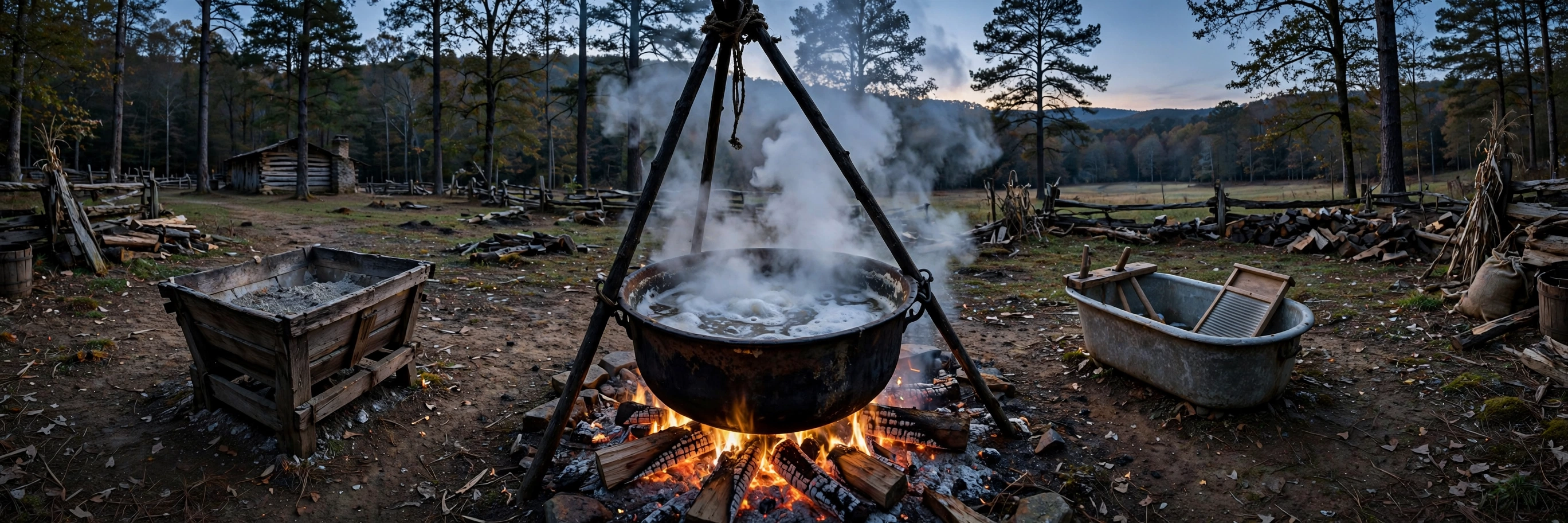
What Was Actually Happening
What looked like a wash day was really a small piece of pioneer chemistry, done the old way from start to finish. Old-school Appalachian soap relied on boiling rendered animal fat, lard mostly, with homemade lye pulled straight out of hardwood ash and rainwater. It was a heavy, zero-waste, cold-process kind of craft, and nothing about it was gentle. What came out of that tub was harsh, highly alkaline soap, meant for laundry and deep scrubbing, or plain rendered bars set aside for treating skin trouble. Nobody wasted a scrap of fat or a bucket of ash to make it.
How It Was Made
Leaching the Lye
- The Hopper. A V-shaped wooden trough, built just for this, called an ash hopper.
- The Ashes. Packed full of saved hardwood ashes, hickory, beech, or ash wood, with straw lining the bottom to act as a filter.
- The Liquid. Rainwater poured slowly over the ashes, dripping out the bottom as a caustic brown liquid, potassium hydroxide, what everyone just called liquid lye.
Rendering the Fat
- The Scraps. Hog fat, beef tallow, and kitchen grease, saved and kept back all year for this.
- The Boiling. Fat scraps boiled with water in a massive cast-iron cauldron until it all melted down.
- The Separation. Once it cooled, the clean fat rose and hardened on top, leaving the water and the leftover cracklings to be scraped away underneath.
Testing the Strength
- No scales. Pioneers had no modern way to measure it, so they used a natural gauge instead, the float test.
- The Egg or Potato. A fresh egg or a whole potato dropped right into the liquid lye.
- Reading It. If it sank, the lye was too weak. If it floated with just a small patch, about the size of a quarter, showing above the surface, it was exactly right.
Boiling and Saponification
- The Mix. Clean rendered fat heated back up in the iron kettle, with the liquid lye stirred in slowly.
- The Paddle. Someone stood over it the whole time, stirring with a long sassafras or ash wood paddle, never leaving it.
- The Transformation. Hours of boiling before the reaction finally took, the oily liquid turning into a thick, jelly-like soap right in front of you.
Pouring and Curing
- The Molds. Hot, thick soap poured into wooden boxes lined with damp cloth, or just left to cool right in the kettle.
- The Cutting. Sliced into rough blocks with a taut wire or a knife, before it hardened all the way through.
- The Aging. Cured for several weeks, letting the extra water evaporate out so the harsh soap mellowed just a little.
And yes, if it was made right, it floated. Seems Ivory was not the only soap that could make that claim.
What I Understand Now
Nobody called it alchemy back then. It was just soap day, same as it had been for her mother and the one before that. But looking back, there was something in that yard worth naming, ash and rain turned to lye, fat rendered down and given new purpose, hours of stirring over an open fire until one thing became something else entirely. I did not know I was watching transformation. I only knew I had a hog to find.
A fire, a paddle, an old iron pot.
A hog who always knew
exactly when to run.
“For he is like a refiners fire, and like fullers soap.” — Malachi 3:2