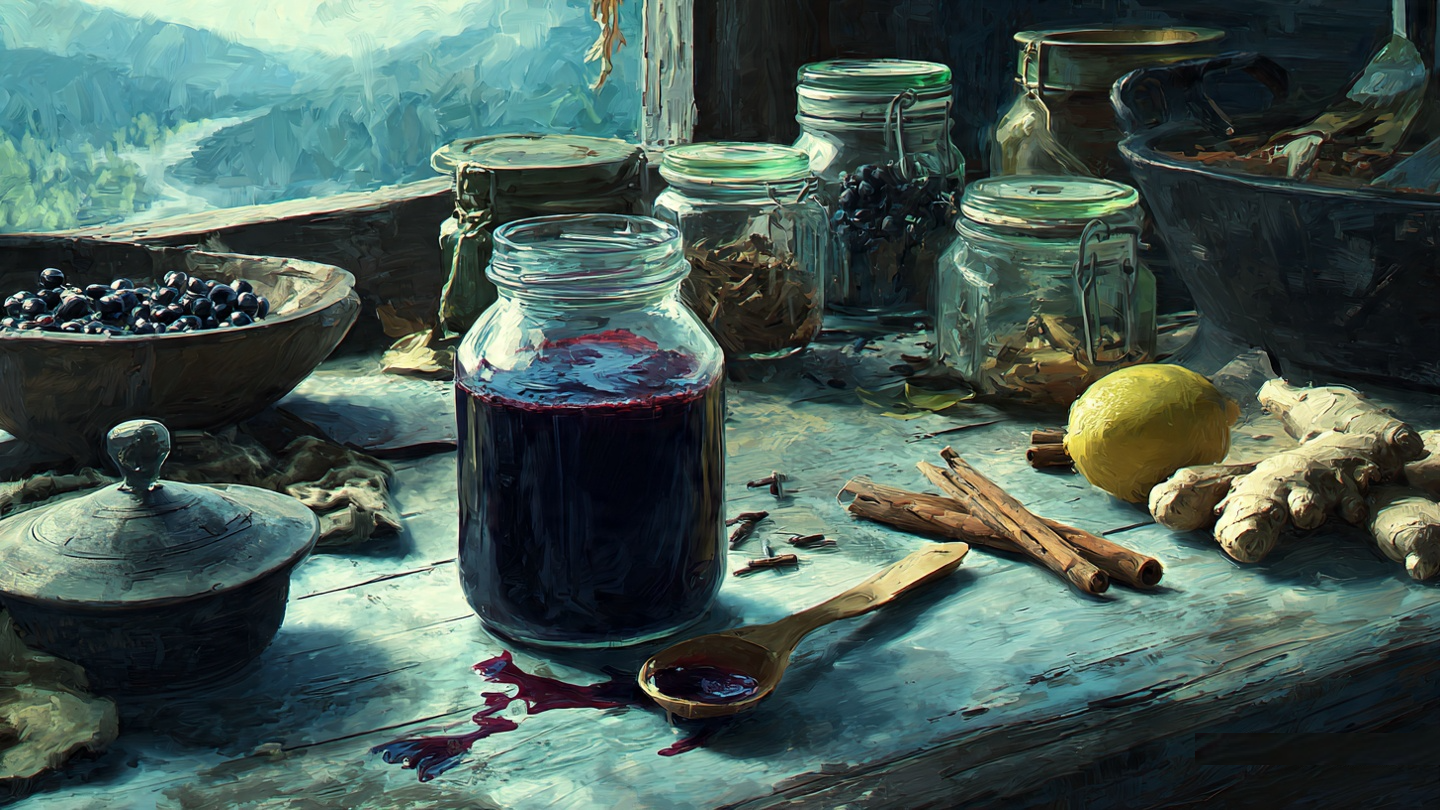
A Plant That Belongs to This Land
American Black Elderberry (Sambucus canadensis) has deep roots in the Blue Ridge Mountains and the hollers and creek banks of Appalachia. It wasn't a trend. It wasn't imported from some European herbal tradition. It grew wild along the fence lines and wood edges, and the women who tended families knew exactly what to do with it — syrup for coughs, jelly for the biscuits, wine for the grown folks come winter.
This is one of those plants that was never forgotten by the people who lived close to the land. The rest of the world is just now catching up.
What Elderberry Does for the Body
Modern herbalists and researchers have spent considerable time confirming what mountain families already knew through practice. The little dark berries carry a lot:
Immune Support
Rich in vitamins A, B, and C — more vitamin C than oranges, ounce for ounce. A daily spoonful is a quiet, steady form of care.
Antioxidant Power
Those deep purple anthocyanins — the same pigment that makes the berry that color — work against inflammation and cellular damage.
Heart & Circulation
Studies point to elderberry's support of cardiovascular wellness, something that matters to any family with a history of heart trouble.
Respiratory Comfort
Traditional use for coughs, congestion, and keeping the chest clear — exactly why Grandma reached for it when the cold settled in.
Gentle on the Gut
Unlike harsh pharmacy supplements, elderberry syrup sits easy on the stomach. Children can take it. Elderly folks can take it.
Everyday Wellness
Not a cure. Not a miracle. Just a small daily choice that adds up — the way all good old-time remedies work: slowly, quietly, and over years.
This is traditional wisdom, not medical advice. Trust your body, listen to your intuition, and consult your healthcare provider for serious concerns.
Know What You're Picking — Elderberry vs. Pokeweed
This part matters. If you're lucky enough to find wild elderberries, or if you're foraging for the first time, you need to know that pokeweed (Phytolacca americana) grows in the same places, at the same time of year, and from a distance the berries can look similar. Pokeweed is highly toxic. Grandma would have taught you this distinction before she taught you anything else about the plant.
Elderberry (Sambucus canadensis)
- Clusters hang in flat, wide umbrella shapes — called a cyme
- Berries are tiny and grow in a web-like, many-branched arrangement
- Stems are woody with opposite leaves and leaflets
- Clusters droop slightly under the weight but spread outward
- Small white flowers bloom in flat-topped clusters before berries form
Pokeweed (Phytolacca americana)
- Berries hang in long, singular grape-like dreadlock clusters
- Bright magenta-pink stems — you can't miss it once you know it
- Plant grows very tall, often taller than a person by late summer
- Berries are rounder and more uniform in size along the stem
- Entire plant is toxic — root, stem, leaf, and berry
Once you've seen them side by side, you will never mix them up again. The elderberry spreads out flat like an open hand. The pokeweed hangs down like a dark braid. Different plants entirely — but worth knowing in your bones before you go picking.
Grandma's Elderberry Syrup
This is the syrup that went over pancakes and into oatmeal. It's also the syrup that came out when someone started coughing. One recipe, many uses — the way good kitchen medicine is supposed to work. If you can't find fresh berries, dried elderberries work beautifully. Just be sure you're buying food-grade dried berries, not capsule fillers.
What You'll Need
- 2 cups fresh elderberries — or 1 cup dried — stems removed (stems are bitter and mildly toxic)
- 3 cups pure water
- 1 cup raw honey — local if you can get it
- 1 cinnamon stick
- 4–5 whole cloves
- 1 inch fresh ginger, sliced
- Zest of 1 lemon (optional, but it lifts the whole thing)
The Ritual
- Prepare with intention Remove berries from stems carefully. This is a good moment to do slowly — it settles you into the work.
- Simmer gently Combine berries, water, and spices in a pot. Bring to a boil, then reduce heat and simmer uncovered for 20 minutes. The kitchen will smell like something good is happening.
- Strain with love Pour through a fine mesh strainer or cheesecloth into a bowl, pressing and mashing the berries to get every bit of that deep purple juice out.
- Cool before the honey goes in This is the step people rush and shouldn't. Let the liquid cool to lukewarm — warm to the touch but not hot. Heat kills honey's beneficial properties, and that defeats half the point.
- Sweeten and bottle Stir in the honey until fully dissolved. Pour into a clean glass jar. Label it with the date.
- Store mindfully Keeps refrigerated for up to 2 months. Take it as a daily practice, not just when you feel bad.
Daily Blessing — How Much to Take
Take it straight off the spoon, stir it into tea, drizzle it over yogurt or oatmeal, or do what Grandma did and pour it right over a stack of pancakes. It's good food and good medicine at the same time.
Beyond the Syrup — Other Mountain Uses
The syrup gets all the attention now because it travels well and the capsules are everywhere. But in the old tradition, elderberry showed up in the kitchen in more than one form:
- Elderberry jelly — made the same way you'd make any wild berry jelly, spread on biscuits all winter long
- Elderberry pie — a deep, dark, slightly tart filling that required knowing your berries were properly cooked
- Elderberry wine — a classic home-brewed mountain tradition, passed down through generations, strictly for the adults
- Dried berries for tea — added to hot water with ginger and honey when fresh wasn't available
The rule that runs through all of it: always cook elderberries before eating them. Raw elderberries — especially in quantity — can cause stomach upset. The heat neutralizes the compounds that cause that. This was known before it was written down anywhere. Grandma knew it because her grandmother knew it.
Some wisdom comes down the family tree
the same way the berry comes down its branch —
in clusters, together, nothing wasted.