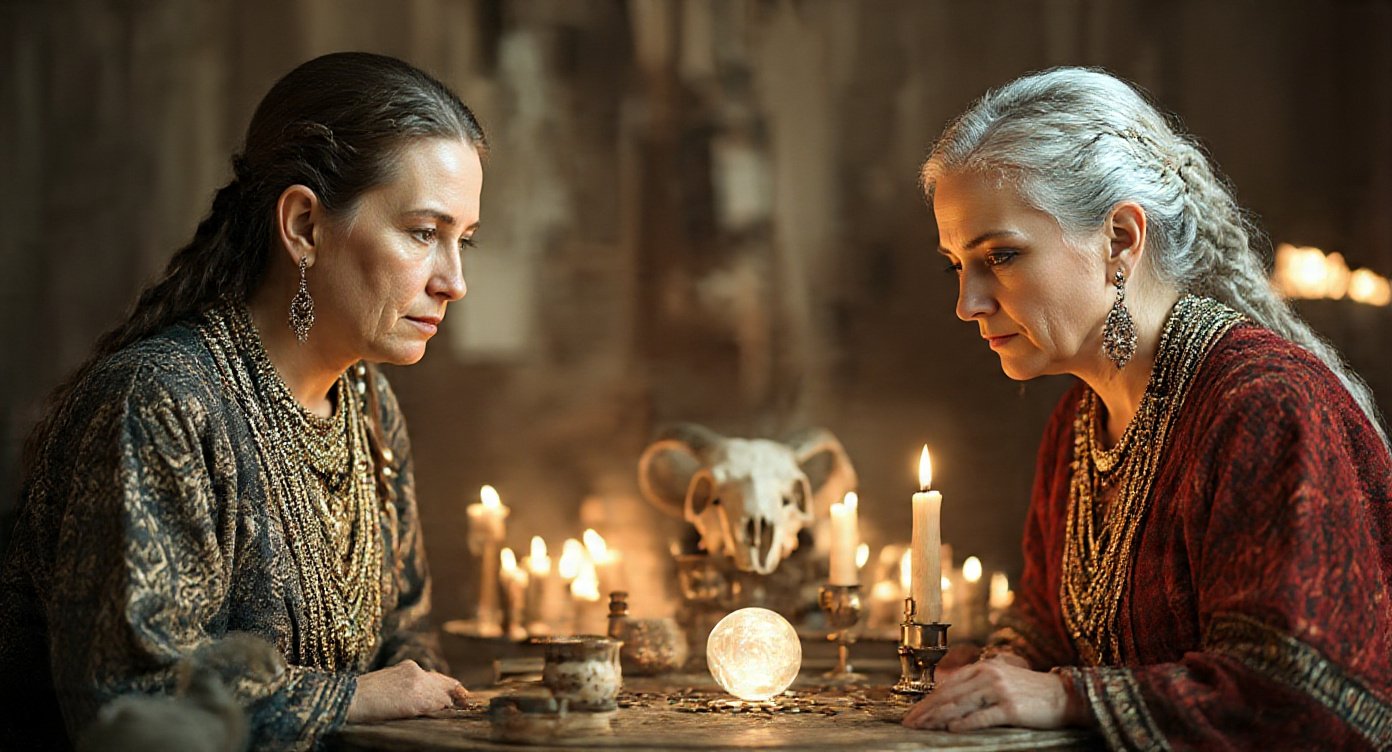
Hollywood blurred the line for decades. These are two distinct traditions — each with a profound history, a living community, and its own sacred logic. If you have ever used the words "Voodoo" and "Hoodoo" interchangeably, this page is for you.
⬡ Two Traditions, One Common Confusion
Vodou
(also spelled Voodoo, Vaudou)
Vodou is a fully formed religious tradition with theology, clergy, congregations, and a rich ceremonial life. It is not a set of spells or a collection of superstitions — it is a living faith.
Originating among enslaved West African people in Haiti, Vodou blended Fon, Ewe, and Yoruba spiritual practices with elements of French Catholicism — not because Africans were converted, but because they strategically layered Catholic imagery over their own sacred figures to survive colonial persecution.
- Origin: Haiti and the African diaspora — rooted in Fon, Ewe, and Yoruba traditions from Dahomey (present-day Bénin)
- Nature: An organized religion with doctrine, clergy, and congregation
- Clergy: Houngans (male priests) and Mambos (female priests) lead initiates and serve the lwa
- Sacred spaces: Peristyles — temples used for public ceremony, healing, and community gathering
- Central practice: Serving the lwa through offerings, drumming, dance, and ritual possession
- Relationship with Christianity: Syncretic — lwa are often paired with Catholic saints; both coexist within the tradition
- Spread: Haiti, New Orleans, Cuba, Brazil, and diaspora communities worldwide
Hoodoo
(also called Rootwork or Conjure)
Hoodoo is a system of folk magic born in the American South — a survival tool forged from necessity by enslaved African Americans. It is not a religion. You don't convert to it, join it, or attend services.
It is practical, earthy, and deeply pragmatic. You work roots to fix a problem: bring love back home, protect the household from harm, draw money, break a curse. It has always coexisted with Christianity — many practitioners were devout church members who also kept a mojo bag in their pocket.
- Origin: American South — created by enslaved Africans blending West African, Native American, and European folk traditions
- Nature: A system of folk magic — not a religion, not a church, not an organized institution
- Clergy: None — practitioners are called rootworkers, conjurers, or two-headed doctors; no formal initiation required
- Sacred spaces: Wherever the work is done — a kitchen, a crossroads, a graveyard
- Central practice: Spellwork using roots, herbs, candles, spiritual baths, mojo bags, floor washes, and petition papers
- Relationship with Christianity: Deeply intertwined — psalms from the Bible are frequently used as verbal components in rootwork
- Spread: Primarily the U.S. South — Mississippi Delta, Georgia, the Carolinas — and wherever African Americans carried the tradition
⬡ Two Branches, One Deep Root
Both traditions trace their ancestry to West and Central Africa — to the Fon and Ewe peoples of Dahomey, the Yoruba of Nigeria, the BaKongo of the Congo Basin, and other nations whose people were forcibly taken across the Atlantic. What we call Vodou and Hoodoo today are testament to survival and adaptation under conditions of extreme violence.
When enslaved Africans were stripped of their languages, families, and homelands, they held onto what colonizers couldn't see clearly enough to destroy: spiritual knowledge, herbalism, cosmology, and the conviction that the world was animated by forces that could be engaged, honored, and worked with. These practices weren't superstition. They were philosophy, medicine, and theology, passed through memory when books were forbidden.
The traditions diverged based on geography and circumstance. In Haiti, under French colonial rule and surrounded by Catholic imagery, the result was Vodou — an organized religion capable of sustaining a community through centuries of oppression and, ultimately, powering the only successful slave revolution in human history in 1804. In the American South, under a different kind of colonial violence, the result was Hoodoo — a decentralized, individual practice that needed no temple because it could live in a tin box under the bed.
They are siblings, not duplicates. They honor many of the same ancestral impulses but chose different forms to survive different storms.
Vodou — The Community Survived
"We serve the lwa together, in ceremony, as a nation. The spirits know us. We know them."
Hoodoo — The Individual Survived
"I carry what I need. The roots, the words, the crossroads. The work goes with me."
⬡ The Lwa — Spirits at the Heart of Vodou
The lwa (also spelled loa) are the central figures of Vodou practice. They are not gods in the Western sense, and they are not demons in the Hollywood sense. They are powerful spiritual intermediaries — forces of nature, ancestral essences, and divine personalities who interact with the human world when properly honored and invoked.
Each lwa has a specific domain, personality, likes and dislikes, preferred colors and foods, and a vévé — a sacred symbol drawn to invite their presence. The supreme creator in Vodou, Bondye, is considered remote and unknowable, so practitioners communicate with Bondye through the lwa rather than directly.
The most well-known lwa are organized into nations or nanchons — groupings that reflect their origins and personalities. The Rada lwa are associated with the cool, sweet forces of creation and healing; the Petro lwa are associated with heat, fire, and fierce power. Neither group is simply "good" or "bad" — they reflect the full complexity of existence.
Papa Legba
Crossroads · Communication · GatewaysOld man at the crossroads who opens the way between the human and spirit worlds. No ceremony begins without first calling on Legba to open the gate. His Catholic counterpart is Saint Peter or Saint Lazarus. He is depicted as an elderly man with a cane.
Erzulie Freda
Love · Beauty · Luxury · GriefThe lwa of romantic love and desire, associated with wealth, jewelry, and longing. She is also associated with profound grief over the impossibility of perfect love. Her Catholic counterpart is Our Lady of Sorrows. Those she rides often weep.
Baron Samedi
Death · Resurrection · Sexuality · MedicineLord of the dead and cemeteries, always dressed in funeral black and top hat, known for crude jokes and a raucous personality. He is also a healer — he decides who lives and who dies. No one dies if Baron has not dug the grave.
Ogou (Ogoun)
War · Fire · Iron · JusticeThe warrior spirit of iron, fire, and righteous conflict. Ogou Feray embodies military power; Ogou Badagri works quietly and diplomatically. Associated with Saint James the Elder. The lwa of Haitian independence — soldiers called on him before battle.
Maman Brigitte
Death · Cemeteries · Justice · HealingWife of Baron Samedi and guardian of graves marked with a cross. She is fierce, foul-mouthed, and deeply just. She protects those buried in her cemeteries and punishes those who desecrate the dead. One of the few lwa with European roots.
Agwe
The Sea · Ships · Fish · SailorsThe lwa of the ocean, protector of all who travel by sea. Deeply important in Haiti, a nation shaped by water. His ceremonies often involve offerings floated out to sea on decorated barques — boats laden with food, rum, and gifts.
⬡ The Tools of Rootwork
Hoodoo is a hands-on tradition. Where Vodou centers on ceremony and relationship with the lwa, Hoodoo centers on the work itself — the preparation, the components, the intention, and the execution. Practitioners have access to a rich pharmacopeia of roots, herbs, minerals, and curios, many of which carry specific traditional uses passed down through generations.
The most important factor in any working is not the ingredient but the practitioner — their knowledge, intention, and personal power. The tools are vehicles, not the source.
Mojo Bag
A small flannel bag filled with herbs, roots, curios, and personal items — essentially a portable spell. Carried on the body, "fed" with oil or whiskey to stay active. Each mojo is unique to its purpose and owner. Also called a gris-gris bag, hand, or toby.
Roots & Herbs
The backbone of the tradition. High John the Conqueror root for luck and power. Low John (Beth root) for love. Five-finger grass for general luck. Lodestone for drawing and attracting. Devil's Shoestring for binding and protection. Each root has a personality and a use.
Candle Work
Dressing and burning candles as petitions and spells. Colors carry specific meanings: red for love, green for money, white for cleansing, black for banishing. Candles may be carved with names or symbols and dressed with condition oils.
Spiritual Baths
Ritual bathing using herb-infused water to cleanse, protect, attract, or influence. A Van Van bath cleanses crossed conditions; an uncrossing bath breaks jinxes. The used bath water may be disposed of at a crossroads or thrown to the east at sunrise.
Petition Papers
Written spells placed under candles, buried, burned, or carried. A name written nine times in a circle, turned sideways and written over with an intention. Honey jars — names placed in sweetened jars to draw favorable outcomes. The written word has power in this tradition.
The Crossroads
The intersection of two roads — especially a dirt crossroads — is a charged magical space in Hoodoo. Used for disposing of certain workings, making deals, and leaving offerings. It is simply where the paths between worlds are thinnest and choices are made.
⬡ How These Traditions Survived
Neither Vodou nor Hoodoo flourished in comfortable conditions. Both exist today because their practitioners were determined, adaptive, and willing to camouflage sacred knowledge when necessary. Understanding their history is essential to understanding why simplifying or sensationalizing them is an act of erasure.
The African Diaspora and the Birth of Hybrid Traditions
Millions of West and Central Africans are enslaved and transported across the Atlantic. Fon, Ewe, Yoruba, BaKongo, and other peoples are forced together, creating new cultural syntheses. Spiritual knowledge is preserved in memory, music, and coded language. In Haiti, the enslaved begin integrating Catholic saints with West African spirits as protective camouflage.
The Haitian Revolution
The Vodou ceremony at Bois Caïman in August 1791 is traditionally cited as the spiritual spark of the Haitian Revolution — the only successful large-scale slave revolt in history. Houngan Dutty Boukman and Mambo Cécile Fatiman led participants in ceremony before the uprising began. Haiti wins independence in 1804.
Hoodoo Takes Root in the American South
Hoodoo consolidates across the Southern United States, drawing on African botanical and magical knowledge, Native American herbalism, and European folk magic traditions. Practiced quietly, often alongside Christianity. Rootworkers serve their communities as folk healers, counselors, and spiritual specialists.
American Occupation of Haiti — and Exploitation of Vodou
The U.S. military occupation of Haiti brings American soldiers and journalists into contact with Vodou. The sensationalized and racist accounts they produce — focused on "zombies" and "savage rituals" — become the foundation of Hollywood's distorted Voodoo mythology. The actual tradition is criminalized under Haitian law at various points.
Hollywood Creates "Voodoo"
The film White Zombie introduces the pop-culture zombie and the evil "Voodoo master" to American audiences — imagery with almost no basis in actual Vodou. The film's success spawns a genre of exploitation films that permanently links "Voodoo" in Western imagination with black magic and ritual horror. This mythology persists today.
Haiti Officially Recognizes Vodou
The government of Haiti grants Vodou legal status as an official religion — a milestone after generations of official persecution. Houngans and Mambos gain the right to perform legally recognized religious ceremonies including marriages. The tradition continues to be practiced by millions in Haiti and across the Haitian diaspora.
⬡ What These Traditions Are Not
Hollywood has had seventy years to build a mythology around these practices. Here is what the actual traditions say.
❌ The Myth
Voodoo dolls are central to both Voodoo and Hoodoo — you stab them to hurt enemies.
✓ The Reality
The "Voodoo doll" as Hollywood presents it has little basis in Vodou practice. Poppets do exist in folk magic traditions worldwide including Hoodoo, but they are used for a wide range of purposes — healing, attraction, protection — not primarily to harm. In Vodou, spirit dolls are consecrated objects for communication with the lwa, not weapons.
❌ The Myth
Zombies are the real, well-known result of Voodoo curses — witch doctors reanimate the dead.
✓ The Reality
The zombie concept in Haitian culture has a specific, sobering meaning: the spiritual state of someone who has had their soul captured — a metaphor for the loss of autonomy under slavery. Ethnobotanist Wade Davis documented rare cases of induced zombie states using neurotoxins, but this was an extreme aberration, not a routine practice. The cinematic zombie is a separate invention entirely.
❌ The Myth
Both practices are forms of devil worship or Satanism.
✓ The Reality
Neither tradition worships Satan or any equivalent figure. Vodou's theology has no devil — it has lwa with varying temperaments. Hoodoo is often practiced alongside Christianity, and its practitioners frequently consider themselves Christian. The "devil worship" narrative was a colonial tool used to justify suppressing African spiritual life.
❌ The Myth
These are primitive superstitions practiced by uneducated people.
✓ The Reality
Both traditions contain sophisticated cosmological systems, botanical pharmacopeia, psychological insight, and theological depth developed over centuries. Vodou priests and priestesses undergo years of rigorous training. Rootworkers maintain encyclopedic knowledge of plant properties and spiritual protocols.
❌ The Myth
Hoodoo and Voodoo are the same thing, just spelled differently.
✓ The Reality
They are distinct traditions — one a religion with organized clergy and theology, the other a folk magic practice with no formal institutions. They share African roots and some overlapping elements, but conflating them is like conflating Catholicism with Celtic herbalism because both have European roots.
Both traditions deserve understanding, not spectacle. These are living practices with millions of practitioners. The communities that carry them forward are not museum pieces or Halloween aesthetics — they are people with a profound inheritance asking only that their traditions be met with honesty.
If this page raised more questions than it answered — that is a good sign. Both traditions are deep enough to spend a lifetime studying. The Hierophant chapter at Tarot Beach will continue to add to this material over time.
Questions, corrections, or your own family tradition to share? Find me in the Tarot Beach community on Facebook.