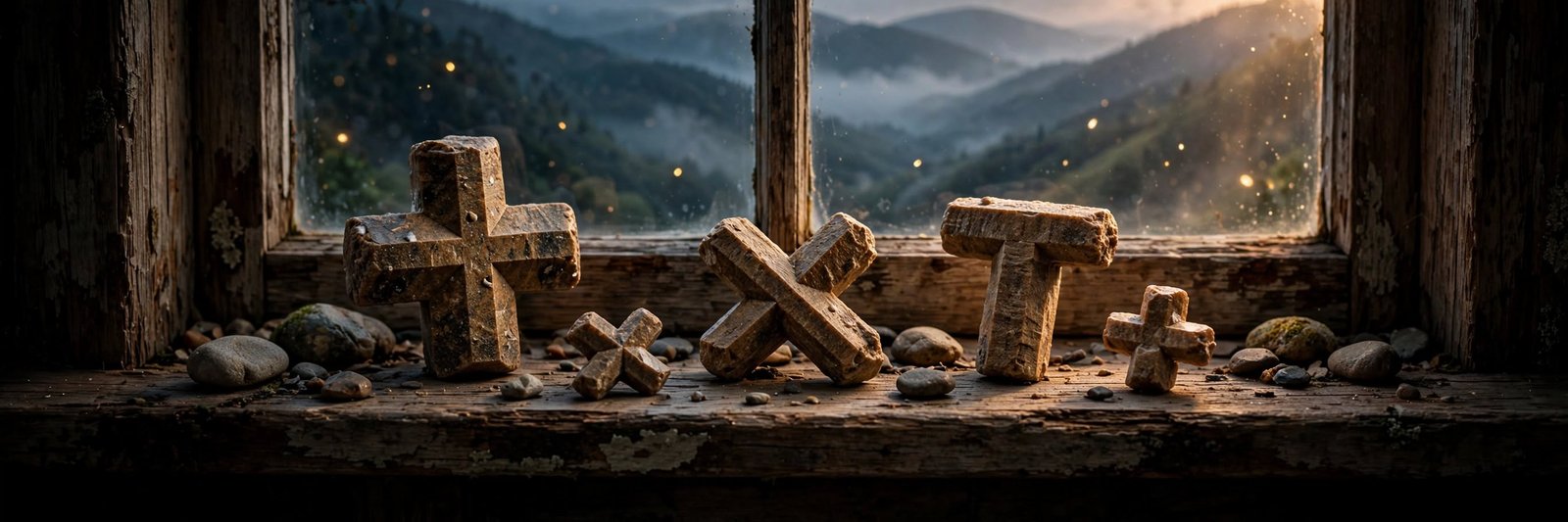
The One on the Windowsill
I did not know what I was holding, and neither did I need to. A stone that looked as though a cross had been woven into it needed no explanation to a child, and it needed none to my grandmother either. She knew it was special, she said so, and she asked me to bring her more.
Five or six in a lifetime is not many. Most of the ones I have seen were just lying there, out in the open, waiting on someone to bend down. And the one that mattered stayed where she put it. What follows is what I have learned since about the little brown stone that sat in her window: what it is, what people have said about it, and where you can go looking for your own.
Describing the Stone
Staurolite is a real mineral, an iron aluminum silicate, and its name comes from the Greek word for cross. It forms deep in the earth where rock is squeezed and cooked during mountain building. The fairy stones of the Blue Ridge are said to have formed miles below the surface when the plates that raised the Appalachians collided. It runs dark reddish brown to brown-black, with a dull glassy to resinous shine, and it is hard, about a 7 to 7.5 on the Mohs scale, harder than the rock around it.
That hardness is how the stones end up on the ground. The soft rock they grew in weathers and washes away, and the crystals stay behind, still whole. Walk a creek bed after a hard rain and you may find one.
The cross is a trick of twinning. Two crystals grow through each other at a set angle, and the angle decides the shape:
- The St. Andrew's cross, an X, where the crystals cross at roughly 60 degrees
- The Roman cross, shaped like a T, and the Maltese cross, a square plus sign, both from crystals crossing at 90 degrees
- The single crystal, a plain six-sided prism, which is what you find most often
The T and the plus sign are the ones collectors prize.
The Legend of the Fairy Tears
The Blue Ridge people who lived on top of these stones had their own explanation for them. Long ago, the story goes, fairies lived in a quiet, remote corner of the foothills, and they danced and played there in the sun. One day an elfin messenger arrived from a far-off city with the news of Christ's death on the cross. The fairies heard the terrible details of the crucifixion and wept, and where their tears fell, they hardened into small stone crosses. The fairies are long gone, the legend says, but the crosses stayed behind to remember them by.
It is a Scots-Irish kind of story, with the fairy folk and the Gospel folded together so neatly you cannot pull them apart. That is how Appalachian faith has always worked, and it may be why a stone that looked like a crucifix made perfect sense on a grandmother's windowsill. Mountain people wore and carried them as luck pieces against illness, accidents, and worse.
The History
Fairy crosses are older than any one story about them, and the stories have grown up around them the way stories do. So here is what is on the record, and what is only said. I have tagged each one.
- DocumentedVirginia's Fairy Stone State Park in Patrick County is named for these stones. The land was donated in 1933, and the park opened on June 15, 1936, as one of the first six Virginia state parks, built by the Civilian Conservation Corps.
- DocumentedBy the early 1920s Virginians had been wearing the crystals as watch charms and necklace pendants for a generation, and a visiting mineralogist noted that some of the stones being sold to the public were genuine and some were artificial.
- DocumentedIn 1976 the Georgia legislature named staurolite the official state mineral.
- LegendThe fairies who wept at the news of the crucifixion, told above and told all through the Blue Ridge.
- HearsayPresidents Theodore Roosevelt and Woodrow Wilson are said to have carried fairy stones for luck. Virginia's own park service repeats it as a rumor, and I have not found a firsthand record.
- HearsayA Georgia tale has Pocahontas giving Captain John Smith a good luck necklace made from a fairy cross. It makes a lovely story, and I can offer nothing to prove it.
Where to Find Them
The best-known place in the world to look is Fairy Stone State Park in Patrick County, Virginia, where the crosses weather out of a vein of rock on the eastern edge of the park. Park staff will tell you to be patient, and to look along trails and in old creek beds after heavy rain has washed the soil away. Check the park's current rules before you pick up or dig anything.
- Virginia: in and around Fairy Stone State Park, Patrick County, near Stuart and Bassett
- Georgia: the mountain counties of the north, Fannin County near Blue Ridge above all, along with Cherokee, Pickens, and Gilmer
- North Carolina: in the Appalachian belt, where rock shops have carried them for decades
- Elsewhere: Taos, New Mexico; Island Park, Idaho; near Blanchard Dam in Minnesota; and Selbu, Norway
A few sensible rules for going after your own: most of the good ground is private or protected, so ask permission before you walk onto it and check the rules of any park, and never assume digging is allowed. In Minnesota, for one, digging the river banks at Blanchard Dam is against the rules. And if you would rather buy than hunt, buy from someone you trust. People have been selling artificial ones for about a hundred years.
Fairy Crosses Today
The stone lives more than one life now.
- Jewelry: local artisans in Virginia still clean and file the crosses down into pendants, charms, and pins. It is the oldest use and the one that has never stopped.
- Collectors: a steady rock-shop and mineral-show favorite, prized above all for a well-formed T or Maltese cross.
- Geology: geologists use staurolite as an index mineral. Where it turns up in a rock, it tells them how hot and how deeply that rock was once buried.
- Industry: the same mineral, ground to sand, has been recovered in the United States as a byproduct of heavy-mineral beach sand in north-central Florida. Sold under names like Starblast, it has been used as an abrasive for sandblasting buildings and finishing metal, and as molding sand in foundries for non-iron metals. The grains are not crosses, but they are the same stone.
- Metaphysical: modern crystal workers carry staurolite as a grounding, protective luck stone, and some credit it with steadying the body's energy. That is folk belief, not medicine, and nothing here replaces a doctor.
Working With Fairy Crosses
Element
Earth
Chakra
Root
Primary Work
Luck, protection, and carrying faith close
Carrying & Keeping
The old way is the simple way: keep one in a pocket or purse, wear one on a chain, or set one where it can be seen and left alone, the way Grandma did. Mountain people carried them against illness, accident, and ill will, and a fairy cross on a windowsill watches over the house from the place where the outside comes in.
Cleansing & Charging
Staurolite is hard and has already survived a trip up from miles below the ground, so it is not fussy. A pass through smoke or a night resting on bare earth is plenty. Do not force anything on it. If you found it yourself, in a creek or on a trail, thank the ground it came out of.
and a child told to bring more.
Five or six in a lifetime,
lying out in the open,
and only the one she kept.
The fairies wept, the old ones say,
and the ground held what they cried.
Grandma kept hers on the sill,
a cross no hand had carved.