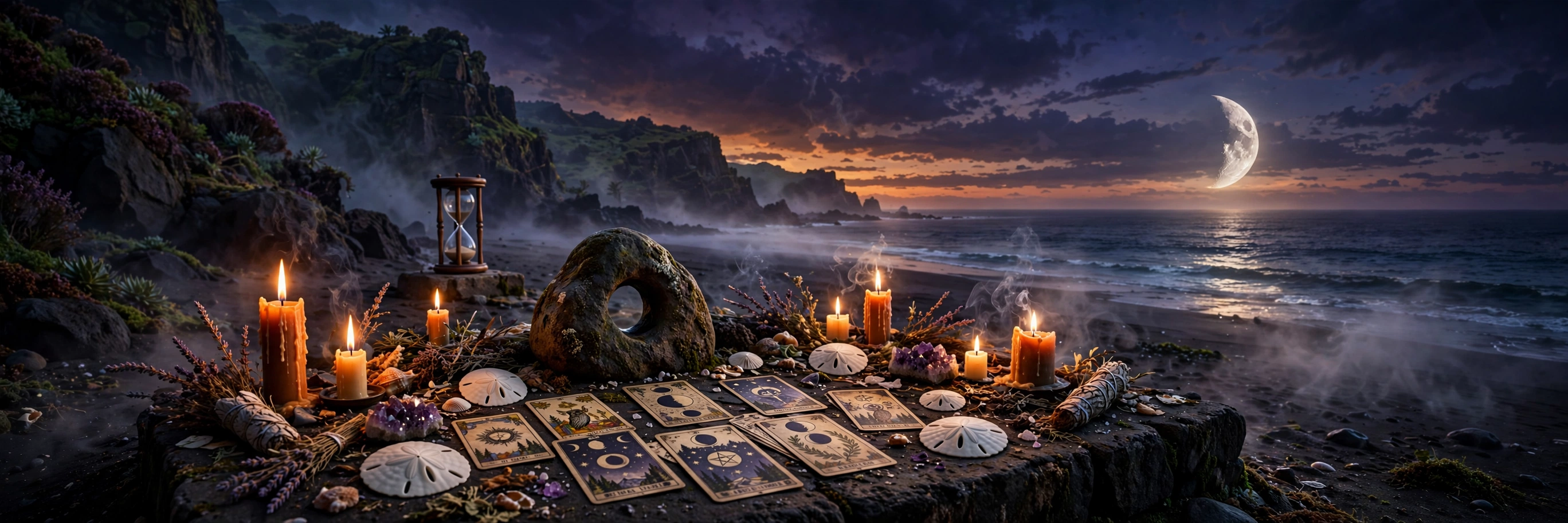
Mad Beach, and What I Carry Home From It
I grew up on Madeira Beach and had the privilege of living there again as an adult, the same year Helene and Milton came through — I call them Mr. and Mrs. Hurricane, since they arrived together and left together. Locals call it Mad Beach, and what makes it wonderful is the sandbar. Depending on whether the tide is in or out, you can wade out to it and walk for a couple of miles in either direction, standing in the middle of the Gulf like the water agreed to hold still for you.
I get a little bothered watching people pull sand dollars up onto a raft to carry them to shore. That's not what I'm there for. What's in my bucket is stones — hag stones, specifically. And I never take one without leaving the hag something in return: a shiny coin. It isn't always a penny, it's whatever coin I happen to have on me, but it has to shine. The hag loves a shiny coin and remembers the time God had her tuck one into a fish's mouth to deliver to a man who needed it — Matthew 17:27. If you've ever picked up a hag stone off the beach, taken it home, and felt like it never did a single thing for you, ask yourself honestly — did you leave your offering?
Found, Not Bought
This practice doesn't need to cost you anything. Gems and crystals are wonderful, but a hag stone is one of the few things the earth hands you for free — as long as you understand that free doesn't mean without a price. Everything the earth gives up for us asks for something back. That's the whole arrangement.
I never once thought about what I could actually do with the stones I was collecting. I just picked them up because I liked them, until I met the Ugly Sea Witch at the Oldsmar flea market. She and her husband run the most wonderful booth there, reading tarot for anyone who sits down. She isn't ugly at all — she's one of the most generous witches you'll ever meet. When the hurricanes took my tarot deck, she was the first one to step up and replace it, because your deck should be given to you, not bought for yourself. She's the one who kept me from missing a step with the hag stones, too.
Describing the Stone
A hag stone is a rock with a hole worn naturally through it — most often by moving water, waves, or sand, though tree roots and boring mollusks will do it too. It doesn't have to come from the water to count. Any stone with a hole cleaned through it by nature, and not by a drill, qualifies. That's the line that matters: the earth has to be the one who made the opening.
The Sea Hag and Her Many Names
A sea hag is the mythical, grotesque water witch these stones are named for — the reason grandmothers everywhere told their children to carry one and leave her something for it. Around the world she goes by different names, and so does the stone: adder stones, holey stones, serpent's eggs, fairy stones, and in Welsh, Glain Neidr. You'll also hear them called witch stones, Odin stones, or holy stones, depending on which coastline you're standing on.
Old Stories From Around the World
Writing in the first century AD, the Roman historian Pliny the Elder recorded a Celtic myth about what he called the serpent's egg — masses of snakes gathering in summer, hissing together, and producing a holed, hardened object out of their own saliva that the Druids would steal away for good fortune. In Welsh tradition that same object survives as Glain Neidr, the Adder Stone.
Scandinavian sailors tied hag stones to their ships with rope to keep witches from clinging to the hull and to ward off storms at sea. And in Norse mythology, the hole itself has a myth behind it — the Prose Edda tells of Odin transforming into a snake and using a magical drill called Rati to bore through a mountain so he could steal the Mead of Poetry. Because of that story, large stones with holes wide enough to pass an arm through were used in early medieval Scandinavia to seal legal contracts and solemnize marriages, with couples holding hands through the hole to swear an unbreakable vow.
Working With Hag Stones
Element
Water and Earth, worked together
Cost
Nothing but an honest offering
Primary Work
Protection, warding, and sight
What It's Used For
- Hung on a red cord over doors, windows, or bedposts to block nightmares and keep negative magic from crossing the threshold
- Held in the car for travel protection, or worn around the neck to keep negative energy at a distance
- Peered through to train your third eye — not to hear the ocean the way you'd hold a conch to your ear, but to see through the veil to spirits otherwise hidden from you
- Tied near the hand while you sleep to encourage vivid, memorable dreams
- Soaked overnight in river or fresh water under a full moon, then used as a wash for thresholds or sprayed through a room to break a hex
How to Work With It
The magic is believed to live inside the stone itself, born from the water that wore the hole through — so most of this isn't complicated spellwork, it's ritual action. Leave your coin every time you take a stone home; that's the first rule and the one that matters most. In Brighton, England, a nineteenth-century practice for changing your luck had you spit through the hole, then throw the stone over your left shoulder into the sea while muttering a prayer for better fortune. Welsh children did something similar with any smooth or holed stone found on a path — spit on it, toss it over your head, and say: Lucky stone, lucky stone, bring me luck when I go home.
To formally set a ward, thread a red cord or natural twine through the hole while stating plainly what you want it to guard against — no nightmare shall pass, no malice shall enter — then tie it off in three or nine knots. If you'd rather charge a stone under sun, rain, and moon the way a lot of modern witches do, a simple spoken charge works just as well:
secrets guard beyond detection.
Honored place in my collection,
guide me in the right direction.
So next time you're wading out to the sandbar at low tide, walking a couple of miles out into the Gulf with a bucket in one hand, leave the sand dollars where they are. Reach for the stone with the hole worn clean through it instead, drop your shiniest coin where you found it, and carry the rest of it home. And if anyone ever asks where I live — just tell them to look for mile marker 666.
he shall preserve thy soul.
The LORD shall preserve thy going out and thy coming in
from this time forth, and even for evermore.